

Blog
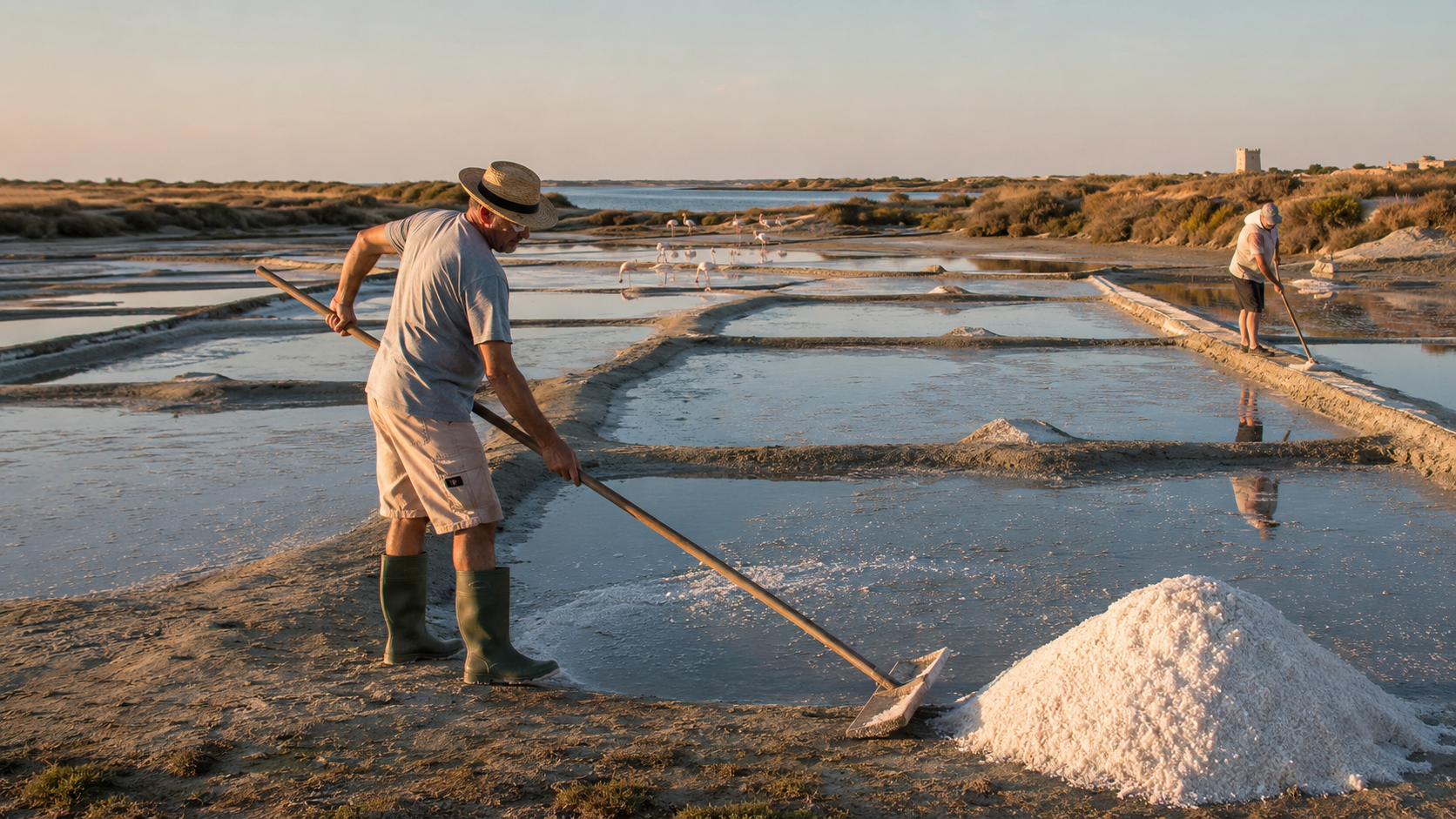
Shimmering expanses where the sea meets the sun, France’s salt marshes still produce salt harvested by hand by paludiers (traditional salt farmers) today. From Guérande to the Camargue, 6 major sites shape this centuries-old tradition. Many can be explored on foot or by little tourist train.
This guide will help you spot the must-see sites, understand the paludier’s trade, and plan your stay!
France’s main salt marshes are spread across 3 major basins: the Atlantic coast, the Camargue and the Var coastline. Luckily, they’re all located close to a waterside campsite. Each area has its own distinct landscape, from tide-swept estuaries to Mediterranean lagoons.
The marshes of Guérande cover almost 2,000 hectares in Loire-Atlantique and are still worked by several hundred paludiers. In Noirmoutier and Île de Ré, production continues on a smaller scale, amid tide-swept lagoon landscapes.
Take a look at our seaside campsites in Loire-Atlantique today!
In the Camargue, the contrast is striking: Salin-de-Giraud spreads out as one of the largest salt works in Europe, its salt pans taking on a pink hue in summer. Its neighbour, Aigues-Mortes, opens its centuries-old salt pans to visitors, alongside its fortified town.
Take a quick look at our waterside campsites in the Gard!
The Salins des Pesquiers in Hyères form a protected nature reserve at the heart of the Giens peninsula. This site is home to numerous migratory birds and can be explored on foot or by bike along marked trails.
« On our portal, searches related to salt marshes peak as summer approaches. Holidaymakers mainly target the campsites closest to the most visited sites, to combine walks around the salt pans with days at the beach. »
Take a quick look at our range of seaside campsites in Hyères!
A salt marsh works through a network of shallow pools where seawater gradually evaporates under the effect of the sun and wind. The paludier guides this flow and harvests the salt by hand, using techniques passed down for more than 1,000 years.
Water enters the vasière, the first settling pool, flows through the cobier and then the fares, before finally reaching the œillets: small square pools where the salt crystallises. Two products are then harvested: coarse grey salt, scraped from the bottom of the œillet, and fleur de sel, a fine white layer skimmed from the surface in hot, windy weather. Guérande salt holds a European protected geographical indication, which safeguards this traditional method.
Good to know: fleur de sel only forms on the surface of the œillets, in hot, dry, windy weather. This thin film of crystals is hand-picked, without ever touching the bottom of the pool. Its rarity explains why it costs more than coarse salt: a paludier harvests only a few kilos a day, and only during the summer season.
France’s salt marshes can be explored on foot, by bike, by little train or by boat, depending on the site. On the programme: visits with paludiers, salt eco-museums, and migratory bird watching.
In Guérande, Terre de Sel offers guided walks where you can meet paludiers hard at work during the harvest. On Île de Ré, the village of Loix is home to the salt marsh eco-museum, which traces the entire production chain. In Aigues-Mortes, the tour takes place aboard a little train through the salt pans, with a stop facing La Camelle, an impressive mountain of salt.
The salt works are among the richest bird habitats along the coast. The Camargue is home to France’s main colony of pink flamingos, visible from the edges of the pools. In Hyères, the Salins des Pesquiers protect a similarly rich birdlife, accessible via marked trails. All you need is a pair of binoculars to enjoy the spectacle.
So, ready to breathe in the sea air of France’s salt marshes on your next stay? On our site, find the campsite closest to Guérande, Île de Ré or the Camargue in just a few clicks, to watch the paludiers at work and make the most of the coastline!
The largest salt marsh in France is Salin-de-Giraud, in the Camargue. With thousands of hectares of salt pans, it ranks among the largest salt works in Europe and is still operated by Groupe Salins for food and industrial salt production.
Yes, most salt marsh sites in France offer tours suited to families. A little train in Aigues-Mortes, an educational trail in Loix on Île de Ré, guided walks in Guérande: children get to discover the paludier’s trade, watch birds, and even taste fleur de sel.
The best time to visit France’s salt marshes runs from June to September. This is harvest season, when the paludiers work in the œillets and the pools take on their most beautiful colours, from brilliant white on the Atlantic coast to intense pink in the Camargue.


