

Blog
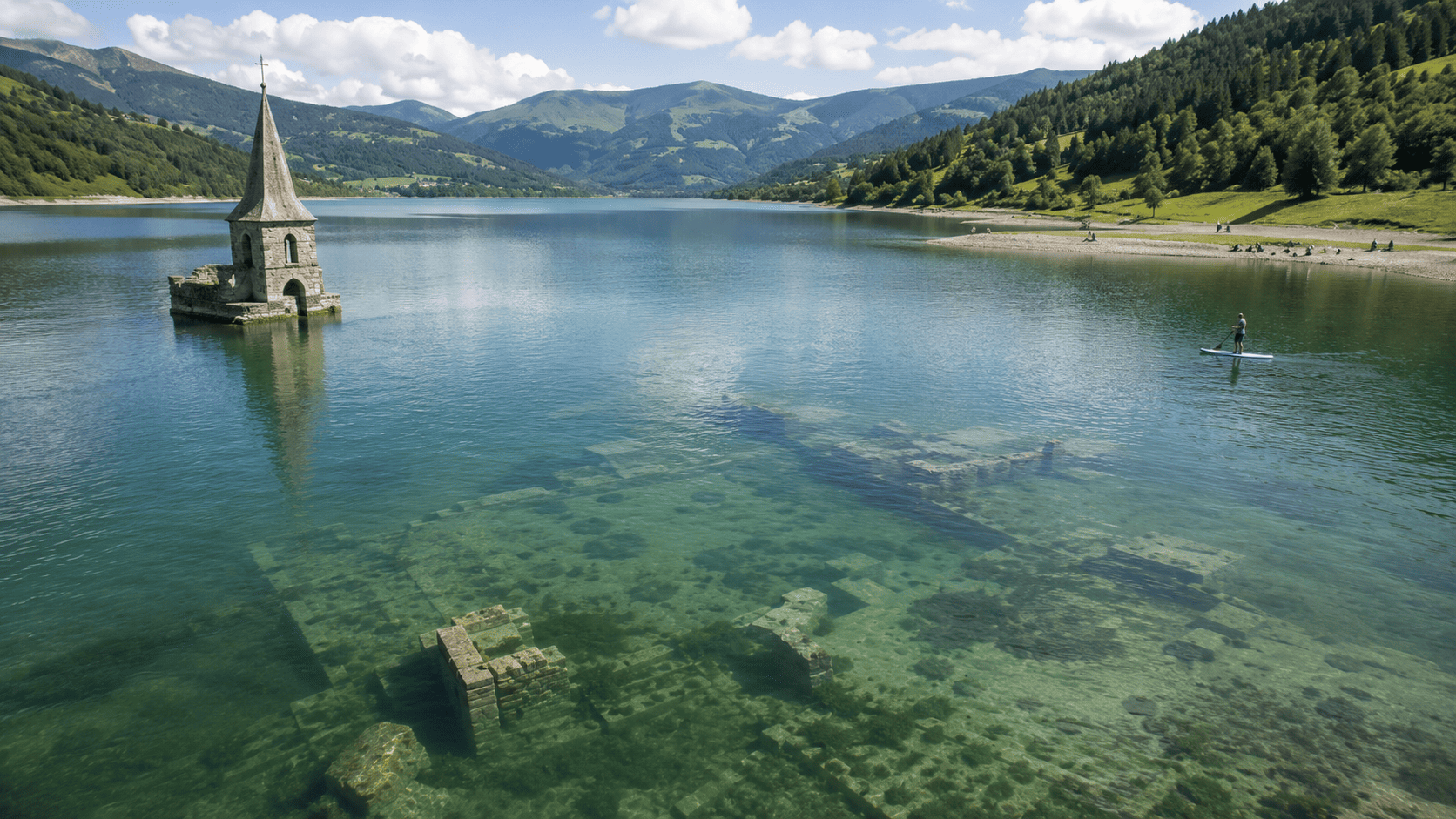
On holiday at a lakeside campsite, you’re often just a few minutes from a forgotten village. Beneath dozens of French reservoirs lie former towns, flooded during the 20th century to generate electricity. These sunken villages of France are easy to discover from the shore, between swimming and walking.
Here are 8 sites where remembrance and relaxation meet!
In Savoie, the old village of Tignes disappeared beneath Lac du Chevril in 1952, when a 180-metre dam flooded the valley and displaced its 400 residents. The town hasn’t completely vanished, though: EDF (the French electricity utility) drains the reservoir every 10 years, revealing the ruins of the church.
Visitors’ favourite feature: the Giant fresco, painted on the dam wall, watching over the flooded valley.
Practical information:
In the Hautes-Alpes, the old village of Savines vanished beneath Lac de Serre-Ponçon in 1961, the largest reservoir in the Alps, forcing almost 1,500 people to leave. Rebuilt right on the water’s edge, the new village has since featured a modern church whose bell tower resembles a ship’s prow facing the lake.
Visitors’ favourite feature: Savines beach, perfect for a swim facing the mountain peaks.
Practical information:
In the Var, Les Salles-sur-Verdon holds a sad record: it’s the last village to be flooded in France, submerged by Lac de Sainte-Croix in 1974. Before the waters rose, its century-old church was even demolished. The town was then rebuilt higher up, facing what has become the country’s 2nd-largest reservoir.
Visitors’ favourite feature: canoeing towards the entrance of the Gorges du Verdon, with its turquoise water.
Practical information:
In the Hérault, Celles had a fate all of its own. Its 80 residents were indeed expropriated between 1965 and 1969 to make way for Lac du Salagou, but the water never actually reached the houses. Left in ruins for decades, the village is now coming back to life thanks to new arrivals.
Visitors’ favourite feature: the red ruffe soil around the lake, an almost Martian landscape.
Practical information:
In the Corrèze, the villages of Port-Dieu, Mallet and Vallette were submerged beneath Lac de Bort-les-Orgues in 1951. The famous Château de Val was also destined for the waters, yet was spared at the last moment, and today its towers stand with their feet in the water.
Visitors’ favourite feature: the view of the Château de Val from a canoe, right in the heart of the Xaintrie region.
Practical information:
In the Champagne region, three villages disappeared beneath Lac du Der-Chantecoq in 1974: Chantecoq, Champaubert-aux-Bois and Nuisement-aux-Bois. Of this past, only the church of Champaubert remains, standing right by the water, while the church of Nuisement was dismantled and rebuilt stone by stone in Sainte-Marie-du-Lac.
Visitors’ favourite feature: watching the common cranes that stop off at France’s largest artificial lake.
Practical information:
In the Lozère, the old village of Naussac and 9 hamlets were flooded by Lac de Naussac, filled with water from 1980 onwards. To keep the community together, its roughly 200 residents were rehoused in a new town built 2 km from Langogne.
Visitors’ favourite feature: the lake’s water sports centre, ideal for sailing and windsurfing.
Practical information:
In the Jura, Lac de Vouglans covered three hamlets and the Charterhouse of Vaucluse in 1968. Now France’s 3rd-largest reservoir, it stretches over 35 km of emerald water today, while the remains of the monastery still lie more than 45 metres below the surface.
Visitors’ favourite feature: the beaches of Bellecin and Surchauffant, with the feel of a Scandinavian fjord.
Practical information:
Fancy staying as close as possible to these lakes steeped in history? After exploring these sunken villages of France, choose your lakeside campsite using our campsite comparison tool for spots right on the water, and book your next waterside getaway!